
Summary
This sheet sets out what the texts say, because the thesis depends on what they are supposed to say. The Treaty came out of the Cold War. After the International Geophysical Year of 1957-58 the research bases of the twelve active countries raised tension, and representatives met in Washington in sixty sessions before the final conference of autumn 1959. The result freezes territorial positions rather than settling them: seven states keep claims, two keep a basis of claim, and Article IV preserves everyone's position. Article V bans nuclear explosions and radioactive waste. Observers of the Consultative Parties may enter any area at any time, and each Party must announce its expeditions and stations in advance. In 1991 the Madrid Protocol added the environmental layer: a ban on any mineral resource activity other than science, in force since 1998, and an impact assessment before activities. Decisions are taken by the 29 Consultative Parties, among 58 Parties in all, with a Secretariat in Buenos Aires. Nothing in these provisions bars tourists or private travellers; they regulate states, their stations, their weapons and their environmental footprint. The next sheets show how this system is presented officially and where its real limits and its real discretion lie.
Verified facts
- Verified fact
The Treaty was negotiated because research bases raised international tension: representatives of the twelve countries active during the International Geophysical Year met in Washington in sixty sessions between June 1958 and October 1959, then at a final conference that ended on 1 December 1959.
- Antarctic Treaty System, Wikipedia
met in sixty sessions between June 1958 and October 1959
- Antarctic Treaty System, Wikipedia
- Verified fact
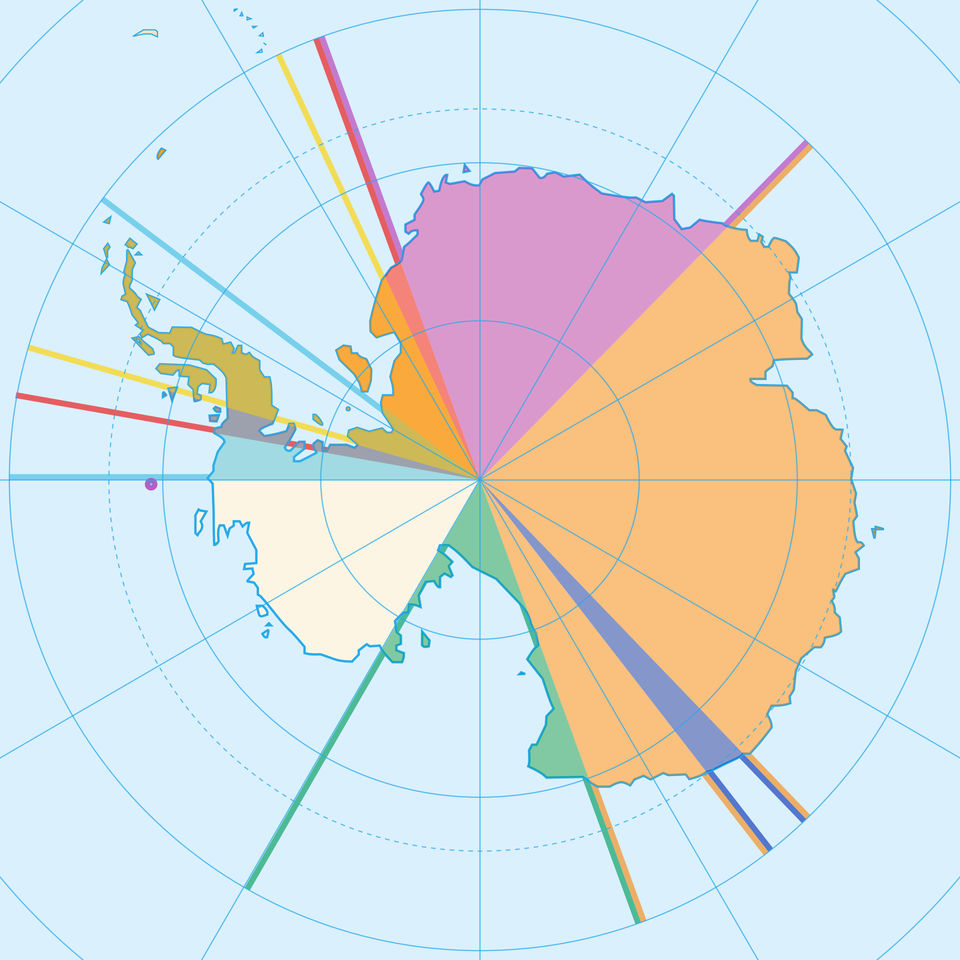
Seven signatories (Argentina, Australia, Chile, France, New Zealand, Norway and the United Kingdom) hold territorial claims, sometimes overlapping; the United States and Russia keep a "basis of claim", and Article IV freezes all these positions without renouncing any.
- The Antarctic Treaty (full text, 1959), Secretariat of the Antarctic Treaty, 1 December 1959
Nothing contained in the present Treaty shall be interpreted as: (a) a renunciation by any Contracting Party of previously asserted rights of or claims to territorial sovereignty in Antarctica
- The Antarctic Treaty, Secretariat of the Antarctic Treaty
The US and Russia maintain a “basis of claim”.
- The Antarctic Treaty (full text, 1959), Secretariat of the Antarctic Treaty, 1 December 1959
- Verified fact
Article V prohibits any nuclear explosion in Antarctica and the disposal of radioactive waste there.
- The Antarctic Treaty (full text, 1959), Secretariat of the Antarctic Treaty, 1 December 1959
Any nuclear explosions in Antarctica and the disposal there of radioactive waste material shall be prohibited.
- The Antarctic Treaty (full text, 1959), Secretariat of the Antarctic Treaty, 1 December 1959
- Verified fact
Observers designated by the Consultative Parties have "complete freedom of access at any time to any or all areas of Antarctica", and the Environmental Protocol requires Parties to co-operate fully with them during inspections.
- The Antarctic Treaty (full text, 1959), Secretariat of the Antarctic Treaty, 1 December 1959
Each observer designated in accordance with the provisions of paragraph 1 of this Article shall have complete freedom of access at any time to any or all areas of Antarctica.
- Protocol on Environmental Protection to the Antarctic Treaty (Madrid, 1991), University of Oslo, Faculty of Law library (treaty text), 4 October 1991
Parties shall co-operate fully with observers undertaking inspections
- The Antarctic Treaty (full text, 1959), Secretariat of the Antarctic Treaty, 1 December 1959
- Verified fact
Under Article VII(5), each Party must give the others advance notice of all its expeditions to and within Antarctica, of the stations its nationals occupy and of any military personnel or equipment it introduces.
- The Antarctic Treaty (full text, 1959), Secretariat of the Antarctic Treaty, 1 December 1959
thereafter shall give them notice in advance, of (a) all expeditions to and within Antarctica, on the part of its ships or nationals
- The Antarctic Treaty (full text, 1959), Secretariat of the Antarctic Treaty, 1 December 1959
- Verified fact
The Madrid Protocol, in force since 1998, states that "any activity relating to mineral resources, other than scientific research, shall be prohibited".
- Protocol on Environmental Protection to the Antarctic Treaty (Madrid, 1991), University of Oslo, Faculty of Law library (treaty text), 4 October 1991
Any activity relating to mineral resources, other than scientific research, shall be prohibited.
- The Antarctic Treaty – What Happens in 2048?, Antarctic and Southern Ocean Coalition (ASOC), 4 October 2024
The Environmental Protocol, which came into force in 1998, builds on this foundation by banning mineral resource activities
- Protocol on Environmental Protection to the Antarctic Treaty (Madrid, 1991), University of Oslo, Faculty of Law library (treaty text), 4 October 1991
- Verified fact
The same Protocol requires an environmental impact assessment before activities are carried out, graded from less than minor to more than minor or transitory impact.
- Protocol on Environmental Protection to the Antarctic Treaty (Madrid, 1991), University of Oslo, Faculty of Law library (treaty text), 4 October 1991
Proposed activities referred to in paragraph 2 below shall be subject to the procedures set out in Annex I for prior assessment of the impacts of those activities on the Antarctic environment
- Protocol on Environmental Protection to the Antarctic Treaty (Madrid, 1991), University of Oslo, Faculty of Law library (treaty text), 4 October 1991
- Verified fact
Only 29 of the 58 parties to the agreements take part in decisions at the annual Consultative Meetings; the other 29 may attend. The Secretariat has been based in Buenos Aires since 2004.
- Antarctic Treaty System, Wikipedia
Only 29 of the 58 parties to the agreements have the right to participate in decision-making at these meetings, though the other 29 are still allowed to attend.
- Antarctic Treaty System, Wikipedia

United Nations