
Summary
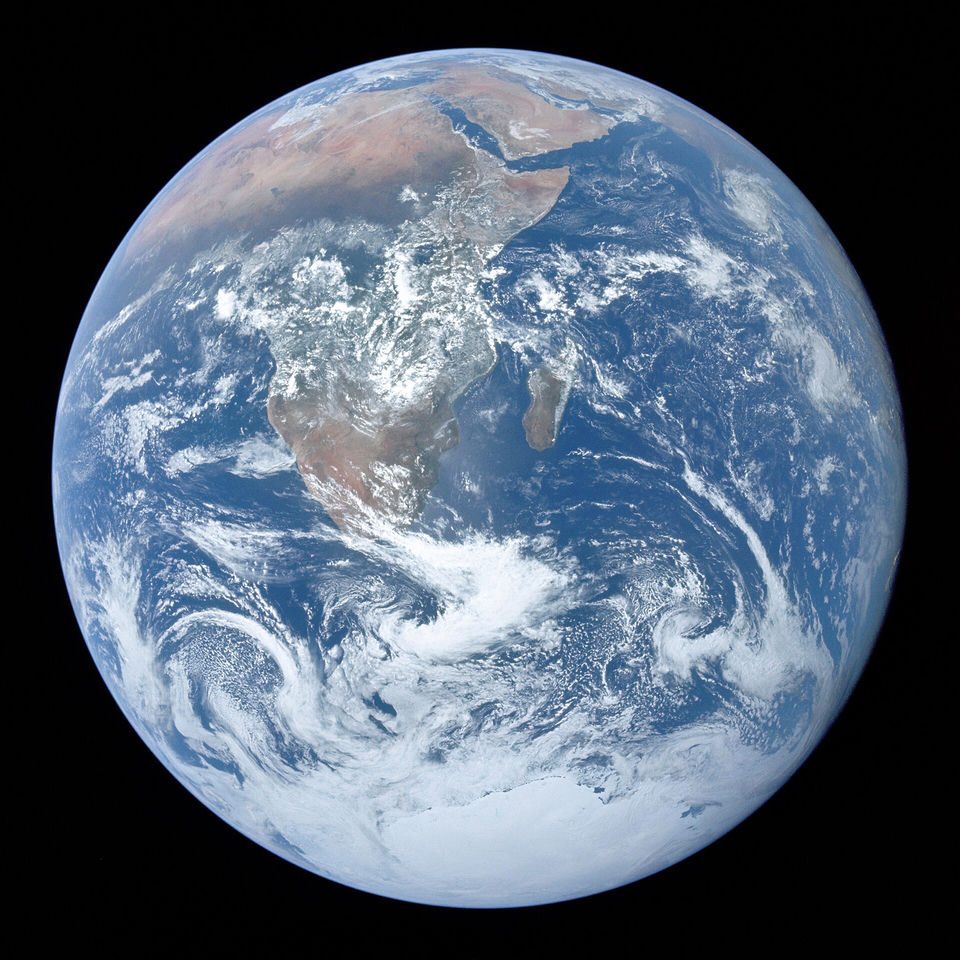
This sheet gathers what the sciences and space agencies say about the sky, point by point against the dome thesis. The atmosphere has no sharp edge: its density falls off exponentially with altitude and it fades into space, and the Kármán line at 100 kilometres is a convention with no distinct physical significance. A fact-check citing NASA material notes that the outermost layer, the exosphere, does not end abruptly with an impenetrable shell but fades into space over thousands of miles. The blue of the sky comes from the scattering of sunlight by air molecules, and stars twinkle because their light crosses the atmosphere; seen from the Moon, where there is none, they do not twinkle at all. On the other side of the sky, Voyager 1 officially became the first human-made object to enter interstellar space, announced in 2013, and the retroreflector left on the Moon by the Apollo 11 astronauts in 1969 still lets laser pulses measure the Earth-Moon distance to a few centimetres. Asked directly about the dome claim, a NASA Goddard communications manager told Reuters that the agency has sent spacecraft far into the solar system and beyond without encountering a dome. These are the positions of institutions and of the scientific literature; they are consistent with each other, and none of them leaves room for a solid vault. What remains open are questions of definition, such as where space is said to begin, not the existence of a barrier.
Official version
- Official version
Earth's atmosphere has no sharp edge: its density decreases exponentially with altitude and it fades into space.
- Where does outer space begin?, Physics Today (American Institute of Physics)
Of course, Earth’s atmosphere has no sharp edge.
- Where does outer space begin?, Physics Today (American Institute of Physics)
- Official version
The Kármán line, at 100 km, is a conventional definition of the edge of space with no distinct physical significance; experts disagree on where the atmosphere ends.
- Kármán line, Wikipedia
there is a rather gradual difference between the characteristics of the atmosphere at the line, and experts disagree on defining a distinct boundary where the atmosphere ends and space begins.
- Kármán line, Wikipedia
- Official version
The sky is blue because air molecules scatter blue light more than red light (Rayleigh scattering), not because of a coloured vault.
- Why is the sky blue?, Royal Museums Greenwich (Royal Observatory)
Therefore, blue light is scattered more than red light and the sky appears blue during the day.
- Why is the sky blue?, Royal Museums Greenwich (Royal Observatory)
- Official version
Stars twinkle because their light crosses the atmosphere; seen from the Moon, where there is no atmosphere, they do not twinkle at all.
- Curiosities: Why do stars appear to twinkle in the night sky?, University of Wisconsin–Madison News, 1 November 2010
Seen from the moon, where there is no atmosphere, stars do not twinkle at all
- Curiosities: Why do stars appear to twinkle in the night sky?, University of Wisconsin–Madison News, 1 November 2010
- Official version
NASA's Voyager 1 is officially the first human-made object to venture into interstellar space, announced in September 2013.
- NASA’s Voyager 1 Reaches Interstellar Space, Johns Hopkins University Applied Physics Laboratory (NASA release), 12 September 2013
NASA’s Voyager 1 spacecraft officially is the first human-made object to venture into interstellar space.
- NASA’s Voyager 1 Reaches Interstellar Space, Johns Hopkins University Applied Physics Laboratory (NASA release), 12 September 2013
- Official version
The Apollo 11 astronauts placed the first laser retroreflector on the Moon in 1969; laser pulses bounced off it give the Earth-Moon distance to about 3 centimetres.
- Measuring the Moon's Distance, NASA Goddard Space Flight Center (eclipse.gsfc.nasa.gov)
The first laser ranging retroreflector was positioned on the Moon in 1969 by the Apollo 11 astronauts.
- Measuring the Moon's Distance, NASA Goddard Space Flight Center (eclipse.gsfc.nasa.gov)
- Official version
Asked about the dome claim, a NASA Goddard communications manager said that NASA has sent spacecraft far into the solar system and beyond and has not encountered a dome; more than 250 robotic spacecraft have flown since 1958.
- Ample evidence NASA rockets have reached outer space | Fact check, USA TODAY (via Yahoo News Canada), 7 July 2023
NASA rockets have successfully entered outer space numerous times since the agency was founded in 1958.
- The Earth is not covered by a dome or 'firmament', Reuters (reprinted by Dunya News), 2 November 2022
NASA has spent spacecraft far into the solar system and beyond, and we have not encountered a dome.
- Ample evidence NASA rockets have reached outer space | Fact check, USA TODAY (via Yahoo News Canada), 7 July 2023
- Official version
The outermost layer of the atmosphere, the exosphere, does not end abruptly with an impenetrable shell but gradually fades into outer space over thousands of miles.
- Fact Check: The Earth Is NOT Flat And Operation Fish Bowl Was A High-Altitude Nuclear Proof Test, Lead Stories, 18 November 2022
does not end abruptly with an impenetrable shell. Rather, it gradually fades into outer space over thousands of miles.
- Fact Check: The Earth Is NOT Flat And Operation Fish Bowl Was A High-Altitude Nuclear Proof Test, Lead Stories, 18 November 2022
NASA Jet Propulsion Laboratory
NASA Space Place