
Summary
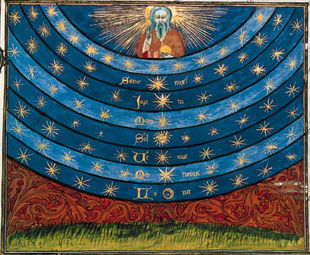
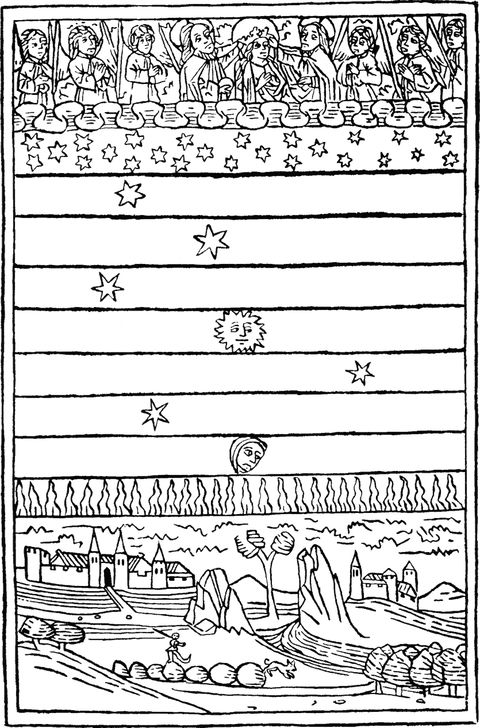
This sheet sets out what history can establish about the idea of a dome over the world. It is a very old picture, not a modern invention. Near Eastern cosmologies described a celestial barrier holding back the waters above the Earth; in the Babylonian epic Enuma Elish the god Marduk makes a dome-shaped firmament from half the body of Tiamat, and Egyptian texts imagined the sky as a goddess, Nut, with the stars travelling along her body. The Hebrew word raqia in Genesis belongs to this family of images, but scholars still disagree about it: standard lexica and some modern scholars read it as a solid dome, while a long conservative tradition reads it as an expanse of air. The picture was challenged early. By about 330 BC Aristotle had given strong evidence of a spherical Earth, and Eratosthenes measured its circumference around 240 BC. In the 16th century Tycho Brahe's observations of comets led him to conclude that the heavens were fluid and simple, ending the belief in hard celestial spheres. The best-known image of the medieval sky, the pilgrim who pokes his head through the vault, is an 1888 engraving published in a book by Camille Flammarion, not a medieval work. The dome of today's flat-Earth movement therefore revives an ancient cosmos that astronomers set aside long ago.
Verified facts
- Verified fact
In Ancient Near Eastern cosmology the firmament is a celestial barrier separating the heavenly waters above from the Earth below.
- Firmament, Wikipedia
the firmament is a celestial barrier that separates the Heavenly waters above from the Earth below.
- Firmament, Wikipedia
- Verified fact
In the Babylonian creation epic Enuma Elish, the god Marduk splits the body of Tiamat and makes with one half a dome-shaped firmament in the sky to hold back her upper waters.
- Genesis creation narrative, Wikipedia
With one half, he creates a dome-shaped firmament in the sky to hold back Tiamat's upper waters.
- Genesis creation narrative, Wikipedia
- Verified fact
Egyptian texts offered several images of the sky, among them a celestial woman, the goddess Nut, across whose body the heavenly bodies travel from east to west.
- Firmament, Wikipedia
The third is a celestial woman, also represented by Nut.
- Firmament, Wikipedia
- Verified fact
Scholars still disagree over the Hebrew word raqia: standard lexica and some modern scholars read it as a solid dome, while a long conservative tradition from Calvin reads it as an atmospheric expanse.
- Rain Water versus a Heavenly Sea in Genesis 1:6-8, Westminster Theological Journal (Vern S. Poythress), 2015
ancient Near Eastern people believed that the sky was a strong solid dome, holding up heavenly waters above it.
- The Firmament and the Water Above, Part I: The Meaning of raqiaʿ in Gen 1:6-8, Westminster Theological Journal (Paul H. Seely), 1991
Conservative scholars from Calvin on down to the present, however, have defined it as an atmospheric expanse.
- Rain Water versus a Heavenly Sea in Genesis 1:6-8, Westminster Theological Journal (Vern S. Poythress), 2015
- Verified fact
By about 330 BC Aristotle had provided strong empirical evidence for a spherical Earth, and the Earth's circumference was first measured around 240 BC by Eratosthenes.
- Flat Earth, Wikipedia
By about 330 BC, his former student Aristotle had provided strong empirical evidence for a spherical Earth.
- Flat Earth, Wikipedia
- Verified fact
Tycho Brahe's study of the comets of 1577 to 1585 led him to conclude that the structure of the heavens was very fluid and simple, against philosophers who divided it into hard, impervious orbs.
- Celestial spheres, Wikipedia
the structure of the heavens was very fluid and simple.
- Celestial spheres, Wikipedia
- Verified fact
The famous engraving of a pilgrim pushing his head through the sky is not medieval: its first documented appearance is in an 1888 book by Camille Flammarion, and it is now seen as a 19th-century illustration imitating older styles.
- Flammarion engraving, Wikipedia
it is now seen as a 19th-century illustration of unknown authorship that imitates older artistic styles and themes.
- Flammarion engraving, Wikipedia