
Summary
Specialists have examined each pillar of the thesis and none stands up. The rapid pole shift that Hapgood and Hancock need is called pseudoscientific: measured true polar wander runs at one degree or less per million years, and the poles have not moved more than about five degrees in 130 million years. Antarctica did move, but slowly, over millions of years, after the break-up of Gondwana. The pyramid in the Ellsworth Mountains is a horn, a peak that forms when glaciers carve several sides of a mountain; it has been surveyed by university teams since its discovery in 1935, and no qualified expert argues it is man-made. Historians of cartography note that the Antarctic reading of the Piri Reis map has been described as a popular but disproven hypothesis, and one assessor wrote that it falls short of strongly suggesting the outline of Antarctica. As for the lost-civilization narrative, scholars call Fingerprints of the Gods pseudoarchaeology, and the Society for American Archaeology asked Netflix to reclassify Ancient Apocalypse as science fiction. The hollow Earth was disproved in the eighteenth century. The ANITA radio events are real but unexplained, and physicists treat them as a question for particle physics.
Official version
- Official version
The cataclysmic pole shift hypothesis is a pseudoscientific claim: measured true polar wander runs at 1° per million years or slower, against up to 1° per thousand years in the hypothesis, and the geographic poles have not deviated by more than about 5° over the last 130 million years.
- Pole shift, Wikipedia
The cataclysmic pole shift hypothesis is a pseudoscientific claim that there have been recent, geologically rapid shifts in the axis of rotation of Earth, causing calamities such as floods and tectonic events or relatively rapid climate changes.
- Pole shift, Wikipedia
- Official version
Antarctica slowly drifted to its current position over millions of years through plate tectonics, not through a sudden shift of the poles or crust.
- Antarctica, Wikipedia
Modern Antarctica was formed as Gondwana gradually broke apart beginning in the Early Jurassic, around 183 Ma.
- Pyramid-shaped peaks in Antarctica are naturally carved by glaciers, not constructed by an ancient civilization, Science Feedback, 9 July 2024
Scientific evidence shows that Antarctica slowly drifted to its current position over millions of years through tectonic plate movement; not a sudden shift of the poles or crust.
- Antarctica, Wikipedia
- Official version
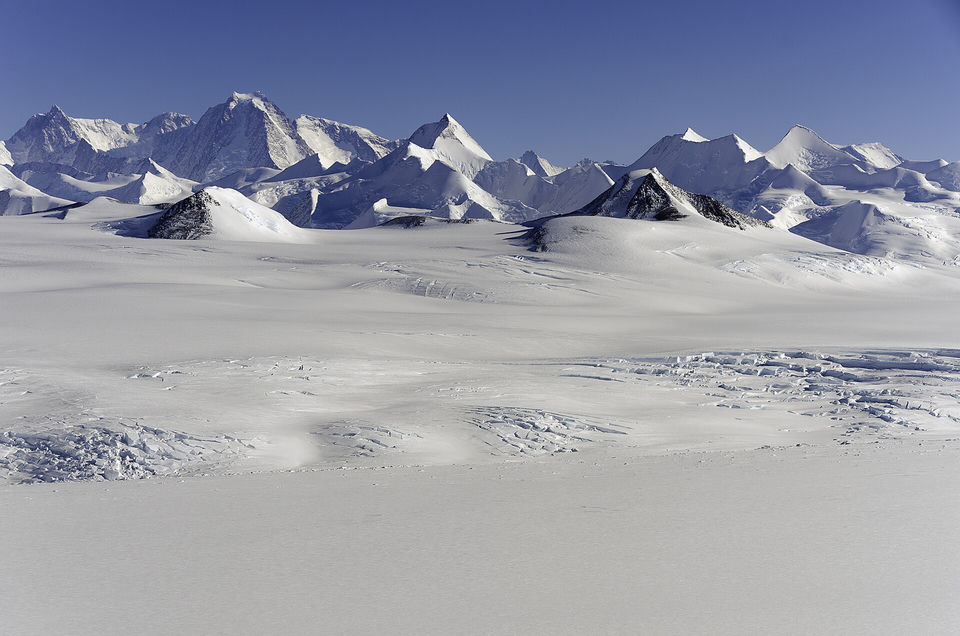
The pyramid-shaped peak in the Ellsworth Mountains is a natural horn carved by glaciers; the range was discovered in 1935 and surveyed by university teams, and no qualified expert argues the peak is man-made.
- Fact Check: NO Qualified Expert Argues Pyramidal Antarctic Peak Is Manmade, Lead Stories, April 2025
Discovered by polar aviator Lincoln Ellsworth in 1935, the mountains have been surveyed in detail by a variety of teams from the University of Minnesota and other academic centers.
- Pyramid-shaped peaks in Antarctica are naturally carved by glaciers, not constructed by an ancient civilization, Science Feedback, 9 July 2024
The rocky pyramid-shaped feature in Antarctica is a natural landform called a ‘horn’ or ‘pyramidal peak’.
- Fact Check: NO Qualified Expert Argues Pyramidal Antarctic Peak Is Manmade, Lead Stories, April 2025
- Official version
Historians describe the idea that the Piri Reis map shows Antarctica as a popular but disproven hypothesis, and one map specialist concluded that Hapgood's claims fall short of proving or even strongly suggesting that the Piri Reis and Finé maps depict the actual outline of Antarctica.
- Charles Hapgood, Wikipedia
they fall short of proving or even strongly suggesting that the Piri Reis map and the Fine map depict the actual outline of Antarctica.
- Piri Reis map, Wikipedia
a popular but disproven hypothesis alleges it to be Antarctica.
- Piri Reis and the Hapgood Hypotheses, Aramco World (Paul F. Hoye, Paul Lunde), January 1980
This part of the Antarctica hypothesis - the key part - is actually the weakest.
- Charles Hapgood, Wikipedia
- Official version
Scholars and scientists describe the proposals of Fingerprints of the Gods as pseudoscience and pseudoarchaeology, and the geological community rejects the crustal-displacement model in favour of plate tectonics.
- Fingerprints of the Gods, Wikipedia
Scholars and scientists describe the book's proposals as pseudoscience and pseudoarchaeology.
- Fingerprints of the Gods, Wikipedia
- Official version
The Society for American Archaeology wrote to Netflix urging it to reclassify Ancient Apocalypse as science fiction rather than documentary; the series had drawn 25 million viewing hours in its first week.
- Ancient Apocalypse, Wikipedia
The Society for American Archaeology objected to the classification of the series as a documentary and requested that Netflix reclassify it as science fiction
- 'Ancient Apocalypse' is more fiction than fact, say experts, Folio, University of Alberta, 14 December 2022
Earlier this month, the Society for American Archaeology wrote a letter to Netflix urging the platform to reclassify the show as “science fiction” rather than “documentary,”
- Ancient Apocalypse, Wikipedia
- Official version
ANITA's anomalous radio events, flagged by a NASA-funded balloon experiment over Antarctica, remain unexplained; IceCube searched eight years of data and found no matches, and proposed explanations include radio waves bouncing through caverns or buried lakes in the ice.
- Antarctic Impulsive Transient Antenna, Wikipedia
As of 2016, these events remain unexplained.
- Are strange space signals in Antarctica evidence of a parallel universe?, Astronomy magazine
But after eight years’ worth of data was searched, the mystery remained
- Antarctic Impulsive Transient Antenna, Wikipedia
- Official version
The hollow Earth notion was disproved, tentatively by Pierre Bouguer in 1740 and definitively by Charles Hutton around 1774, and by Symmes's time it was no longer a scientifically viable hypothesis.
- Hollow Earth, Wikipedia
the notion was later disproven, first tentatively by Pierre Bouguer in 1740, then definitively by Charles Hutton in his Schiehallion experiment around 1774.
- Hollow Earth, Wikipedia