
Summary
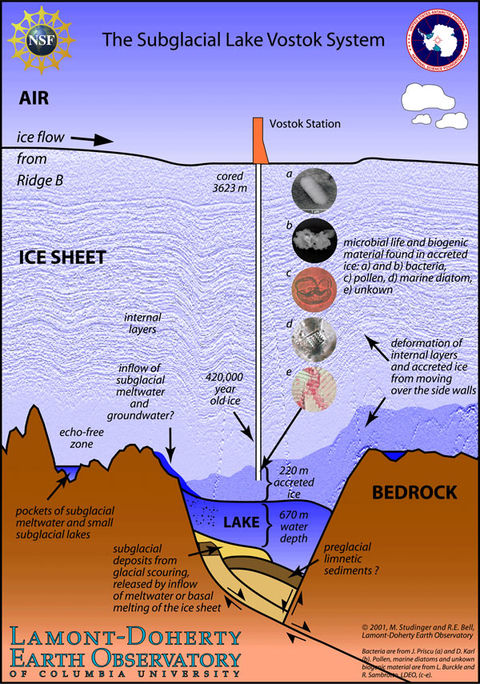
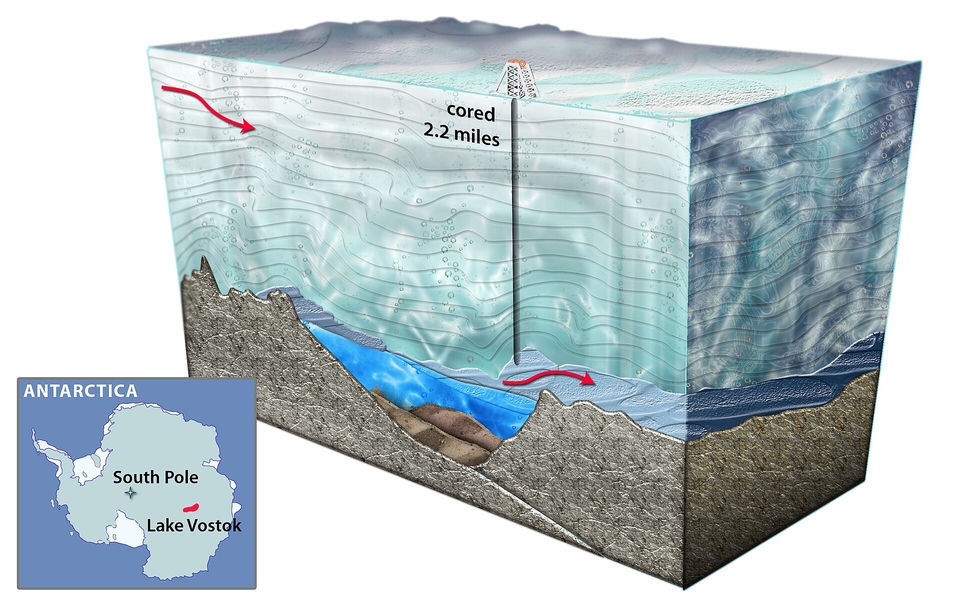
There is a hidden world under the Antarctic ice, and it is a documented one. The ice sheet covers 98% of the continent, over 14 million square kilometres, with an average thickness of more than two kilometres. Beneath it lie 675 known subglacial lakes, the largest being Lake Vostok, over 250 km long and sealed under about four kilometres of ice; its existence was confirmed in 1993, and Russian drillers pierced the ice to its surface in February 2012. What lives there is still debated: accretion ice, frozen lake water at the base of the ice, has yielded traces of microbes, and a 2013 study reported thousands of sequences, though contamination remains a concern. A cleaner sample came from Lake Whillans in 2013, where researchers found bacteria and a NASA-designed mini-submarine filmed the lake floor. The continent also holds a surprising past: sediment from the seabed off West Antarctica contains roots, pollen and spores of a temperate rainforest that grew about 90 million years ago. As for people, Antarctica has no native human population, only about 5,000 people at research stations in summer, and the Antarctic Treaty bans military operations there and relies on on-site inspections. Nothing in these findings points to a city or a settlement.
Verified facts
- Verified fact
The Antarctic ice sheet covers 98% of the continent, about 14 million square kilometres, with an average thickness of over 2 kilometres.
- Antarctic ice sheet, Wikipedia
The Antarctic ice sheet is a continental glacier covering 98% of the Antarctic continent, with an area of 14 million square kilometres (5.4 million square miles) and an average thickness of over 2 kilometres (1.2 mi).
- Antarctic ice sheet, Wikipedia
- Verified fact
Lake Vostok is the largest of Antarctica's 675 known subglacial lakes; it is more than 250 km long and lies beneath 3.7 to 4.2 km of ice.
- Lake Vostok, Wikipedia
is the largest of Antarctica's 675 known subglacial lakes and the 16th largest lake in the world by area.
- Vostok Subglacial Lake: A Review of Geophysical Data Regarding Its Discovery and Topographic Setting, NASA Technical Reports Server (Siegert, Popov, Studinger), 2011
The lake is more than 250 km long and around 80 km wide in one place. It lies beneath 4.2 to 3.7 km of ice
- Lake Vostok, Wikipedia
- Verified fact
The existence of Lake Vostok was confirmed in 1993 by laser altimetry, and on 5 February 2012 Russian scientists pierced the ice shield to the surface of the lake.
- Lake Vostok, Wikipedia
the final confirmation of the existence of the lake in 1993 by J. P. Ridley using ERS-1 laser altimetry.
- Lake Vostok, Wikipedia
- Verified fact
A 2013 study of ice that froze onto the base of the ice sheet above Lake Vostok reported more than 3,500 unique traces of life, mostly bacteria and fungi, but contamination has long plagued reports of life from the Vostok ice cores and the lake water itself has not been sampled.
- Ice Above Lake Vostok Includes DNA From Animals, Live Science
Now, a new study of genetic material in the accretion ice reveals more than 3,500 unique traces of life in Lake Vostok, including animals, from a wide variety of ecosystems.
- Ice Above Lake Vostok Includes DNA From Animals, Live Science
- Verified fact
In January 2013 the WISSARD expedition sampled subglacial Lake Whillans for microbial life; the sediments held 3,914 bacterial species, and a NASA-funded mini-submarine filmed the lake floor after descending an 800-metre borehole.
- Subglacial lake, Wikipedia
In January 2013, the US-led Whillans Ice Stream Subglacial Access Research Drilling (WISSARD) expedition measured and sampled Lake Whillans in West Antarctica for microbial life.
- What Lies Beneath: NASA Antarctic Sub Goes Subglacial, NASA Jet Propulsion Laboratory, 28 February 2013
A video camera on a NASA-designed-and-funded mini-submarine captured this view as it descended a 2,600-foot-deep (800-meter-deep) borehole to explore Antarctica's subglacial Lake Whillans.
- Subglacial lake, Wikipedia
- Verified fact
A sediment core taken in 2017 near West Antarctica's Pine Island Glacier contains a forest soil from the Cretaceous, with roots, pollen and spores of a temperate rainforest that grew about 90 million years ago.
- Temperate rainforests near the South Pole during peak Cretaceous warmth, Nature (Klages et al.), 1 April 2020
The mid-Cretaceous period was one of the warmest intervals of the past 140 million years
- New discovery: Evidence for a 90-million-year-old rainforest near the South Pole, Northumbria University, 1 April 2020
The evidence of Antarctica’s rainforest comes from a core of sediment taken from the seabed near West Antarctica’s Pine Island Glacier in 2017.
- Temperate rainforests near the South Pole during peak Cretaceous warmth, Nature (Klages et al.), 1 April 2020
- Verified fact
Antarctica is Earth's only continent without a native human population; about 5,000 people live at research stations in summer, and about 1,000 in winter.
- Antarctic Treaty System, Wikipedia
regulate international relations with respect to Antarctica, Earth's only continent without a native human population.
- Antarctica, Wikipedia
During the summer months, about 5,000 people reside at research stations, a figure that drops to around 1,000 in the winter.
- Antarctic Treaty System, Wikipedia
- Verified fact
The Antarctic Treaty, signed in 1959, prohibits nuclear testing, military operations and economic exploitation, and is monitored through on-site inspections.
- Antarctic Treaty System, Wikipedia
The treaty prohibits nuclear testing, military operations, economic exploitation, and the making of new territorial claims in Antarctica. It is monitored through on-site inspections.
- Antarctic Treaty System, Wikipedia

NASA Jet Propulsion Laboratory